In the 1970s, Enzo Mari designed objects for Danese intended for public spaces and offices.
The designer and Bruno Danese agree that these environments are very important in everyday life and therefore deserving of attention, just like domestic spaces.
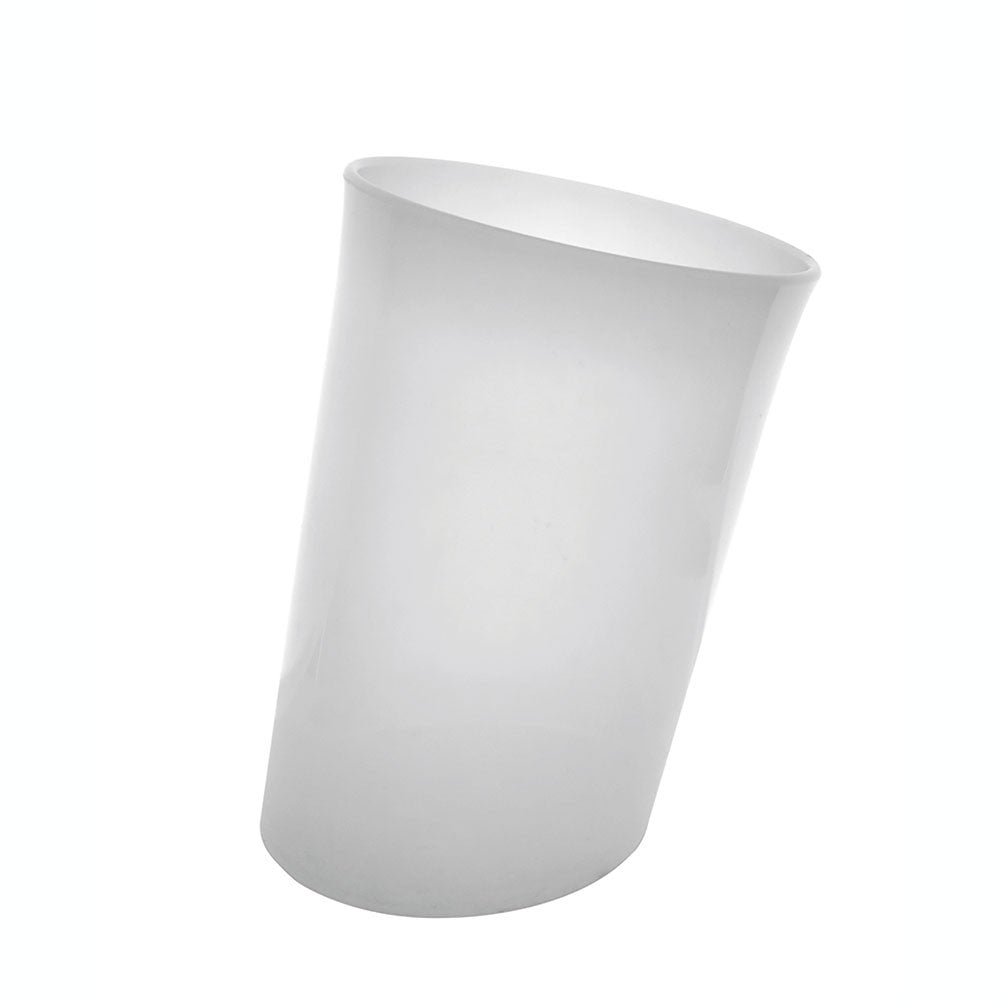
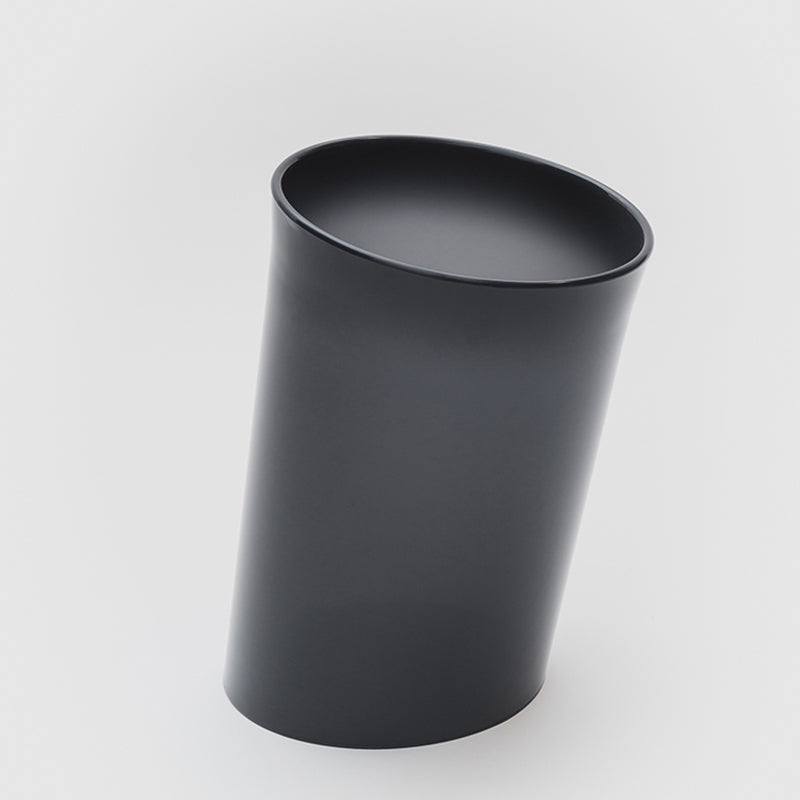
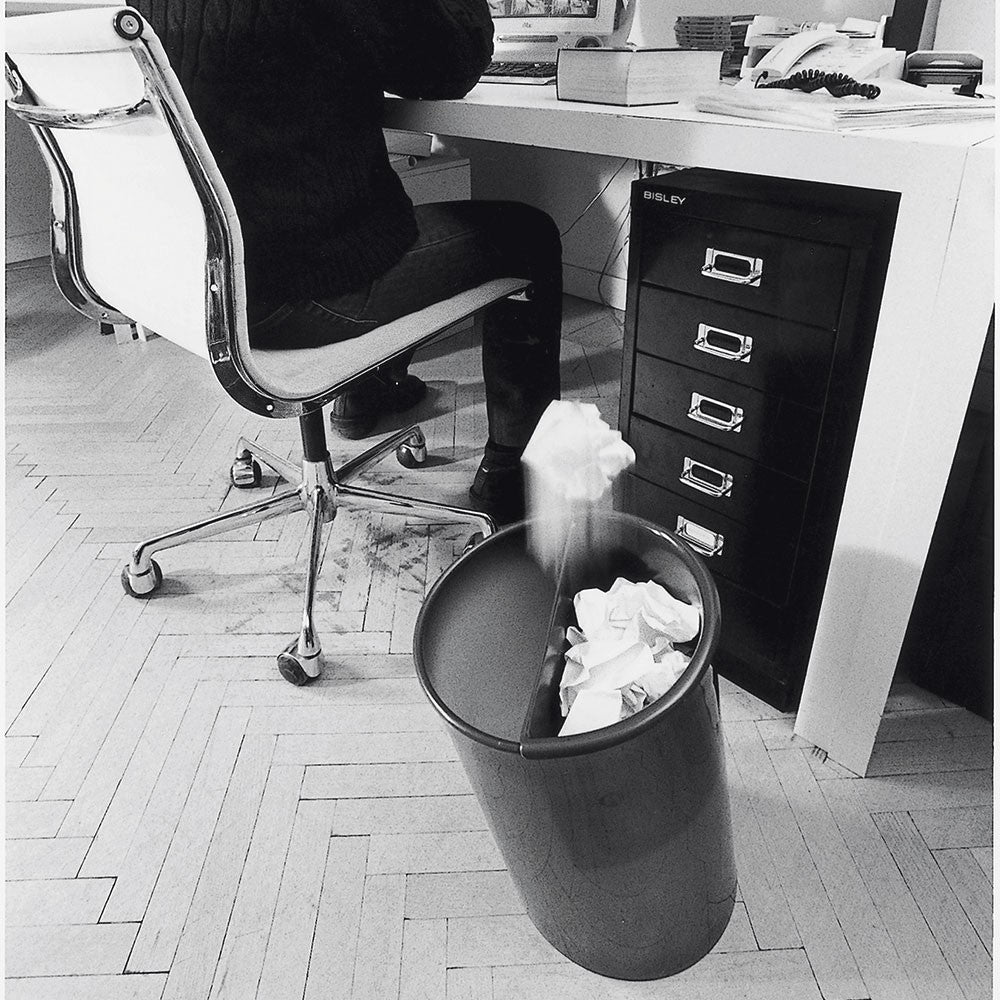
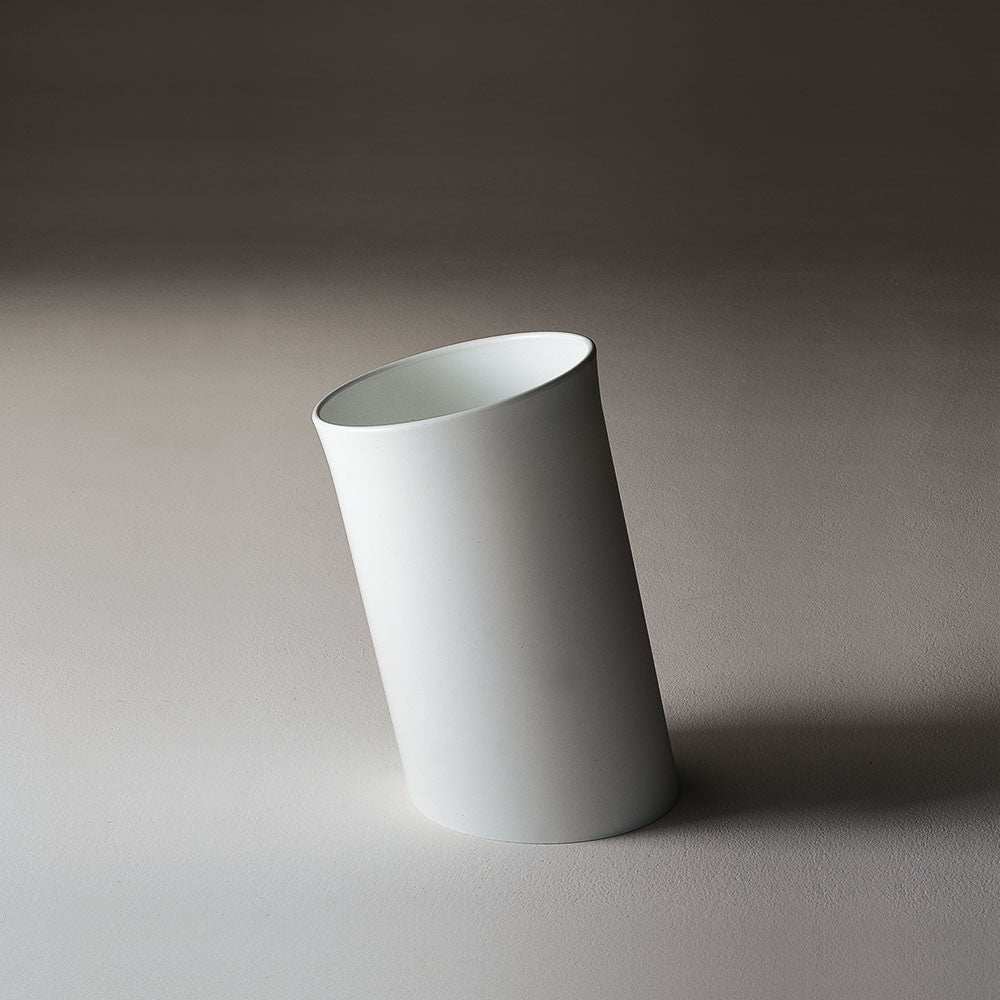
The In attesa wastebasket project, numbered 1042 by the designer and developed in collaboration with his brother Elio, was produced in 1971. It is an injection-molded polypropylene cylinder that stands out from current wastebaskets thanks to the transverse cut at the base. This cut creates a subtle slope of the container, making it more suitable for waste collection.
Enzo Mari was born in Novara in 1932. He completed his education at the Academy of Fine Arts in Milan, which he complemented by an intense artistic activity from the 1950s, with solo and group exhibitions in galleries and contemporary art museums. In 1963, he coordinated the Italian group "Nuove Tendenze" and in 1965 curated its exhibition of optical, kinetic, and programmatic art at the Zagreb Biennial.
He participated individually in various editions of the Venice Biennale and the Milan Triennale. At the same time, he began working in design, initially as a personal formal researcher, and then in collaboration with numerous industries in the fields of graphics, publishing, industrial products, and exhibition design.
A hallmark of his work, which has established itself internationally as one of the most representative of Italian design, is the constant research and experimentation with new forms and meanings for products, even in opposition to traditional industrial design schemes.
In 1971, he participated with a critical intervention in the exhibition "Italy: the New Domestic Landscape" at the MOMA in New York. His singular position as an artist-designer is documented in the many publications dedicated to his work, as well as in interventions at important institutions dedicated to his work, including the Association for Industrial Design, of which he was President from 1976 to 1979.
He has been awarded the Compasso d'Oro prize three times. His works and objects are in the collections of various contemporary art museums: the Galleria Nazionale d'Arte Moderna in Rome, the Moderna Museet in Stockholm, the Stedelijk Museum in Amsterdam, the Musée des Arts Décoratifs, the Kunstmuseum Düsseldorf, the Kaiser Wilhelm Museum in Krefeld, and the Museum of Modern Art in New York.
A major solo exhibition was held in 1983 by the University of Parma's Communication Study Center and Archive, which houses 8,500 drawings and works from his archive, which he donated to the CSAC.
More recently, his work has extended to research and design for urban planning (Milan City Council, redevelopment of the Piazza del Duomo) and teaching, through conferences and lecture series in Italy and abroad, including courses held at the Institute of Art History at the University of Parma and the Faculty of Architecture at the Milan Polytechnic.