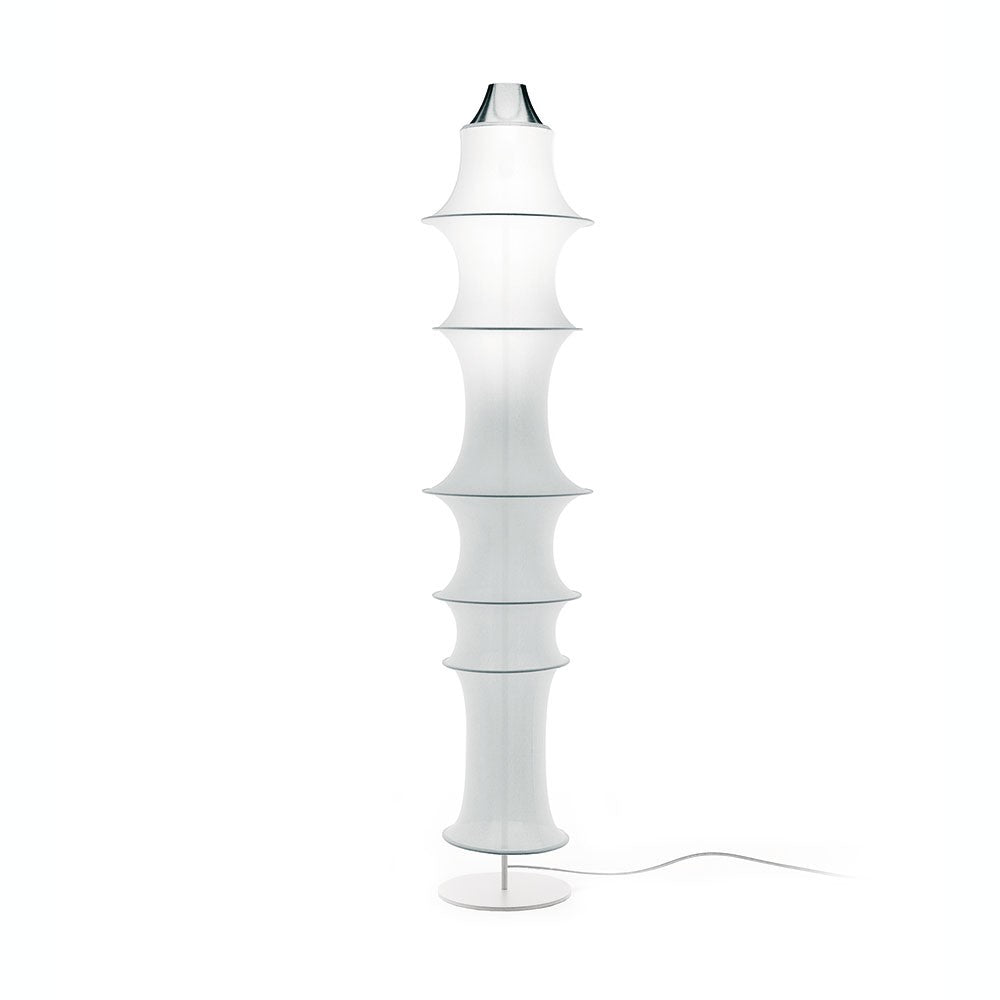
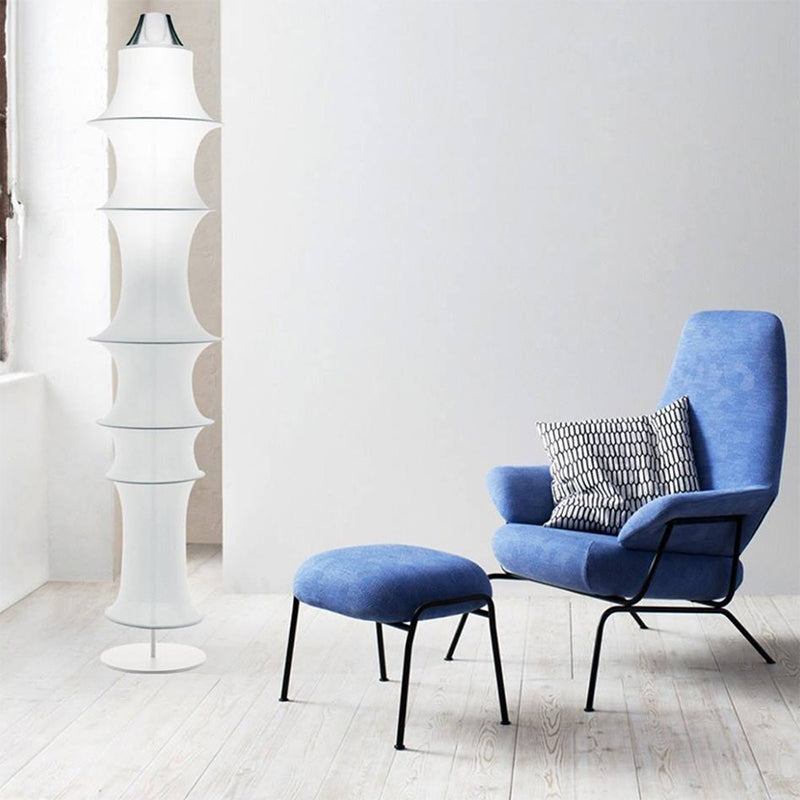
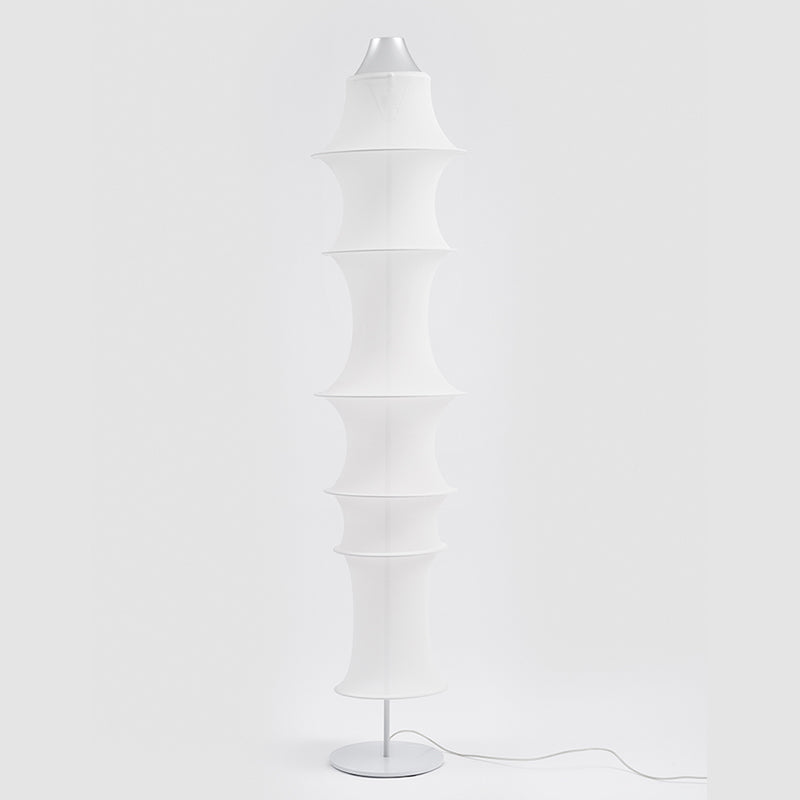
Diffuser in white tubular elastic mesh, structure in natural aluminium.
The shape of the 'Falkland' lamp is born from the tension of a filanca tube and the weight of some metal rings: it is a spontaneous form, generated solely by the tension of the internal forces that compose it.
Seven metal rings of different diameters, a white filanca tube, a single light bulb and an aluminum reflector that reflects the curves of the fabric.
This lamp corresponds more than the others to the requirements that Munari indicates as essential for correct design: simplicity, efficiency, minimal storage space and maximum formal yield.
It is born from the combination of very distant objects, such as fishing nets, women's stockings and oriental paper lamps.
Standing over 1.60 meters tall, it compacts into just a few centimeters of space. The light filters through the tube, using the texture of the fabric to create a distinctive soft, diffused light effect.
Bruno Munari is one of the greatest protagonists of 20th-century Italian art, design, and graphics.
Throughout his artistic career he has maintained his creativity unchanged in support of his investigations into form, experimenting and communicating it through words, objects and toys.
He began his career close to the Futurist movement, participating in group exhibitions at the Galleria Pesaro, the Venice Biennale, and the Quadrennials in Rome and Paris, but later distanced himself from the movement to explore more deeply the fields of form and color, and the aesthetic autonomy of objects. Among his most emblematic works are the "useless machines," mechanical devices that explore the possibilities of perception, presented as "experimental models intended to verify the possibilities of aesthetic information in visual language," works that predate optical art. From 1934 to 1936, he devoted himself to abstract painting.
Together with A. Soldati, G. Monnet, and G. Dorfles, he founded the MAC (Movement for Concrete Art). Since the 1950s, he has produced "concave-convex" sculptures, "positive-negative" paintings, and experimental three-dimensional models. He has received several awards during his lifetime, including the Compasso d'Oro from the ADI (1954, 1955, 1970, and 1995 for his lifetime achievement), the Japan Design Foundation Award in 1985, and an honorable mention from the New York Academy of Sciences in 1974.